Why Requirements Matter So Much for AI Coding Agents
AI coding agents are impressive. Give them a prompt, and they can scaffold apps, write tests, refactor code, and even debug tricky issues. That speed makes them feel almost magical. But anyone who has used them on a real project learns the same lesson quickly: the quality of the output depends heavily on the quality of the requirements.
Requirements are not bureaucratic overhead. They are the map for what to build. A human developer can often fill in missing context through experience, conversation, and judgment. An AI coding agent cannot do that reliably. Combine that limitation with the agent’s speed, and you get a recipe for disaster. High-speed development does not help when you move in the wrong direction.
So how do teams find the right direction? With requirements. But as with all important things, it is not as easy as it looks.
Requirements are really about managing knowledge
One useful way to think about requirements comes from the four knowledge quadrants: known knowns, known unknowns, unknown knowns, and unknown unknowns. The names sound abstract, but they describe the reality of software projects surprisingly well.
They also explain why AI coding agents can feel brilliant one moment and deeply frustrating the next. The agent moves fast through what the team has made explicit. It struggles with what the team has not surfaced, not decided, or not even noticed yet.
That makes requirements less about documentation and more about knowledge management. The better the team maps what it knows and what it does not, the better the agent performs.
The 4 quadrants of requirements
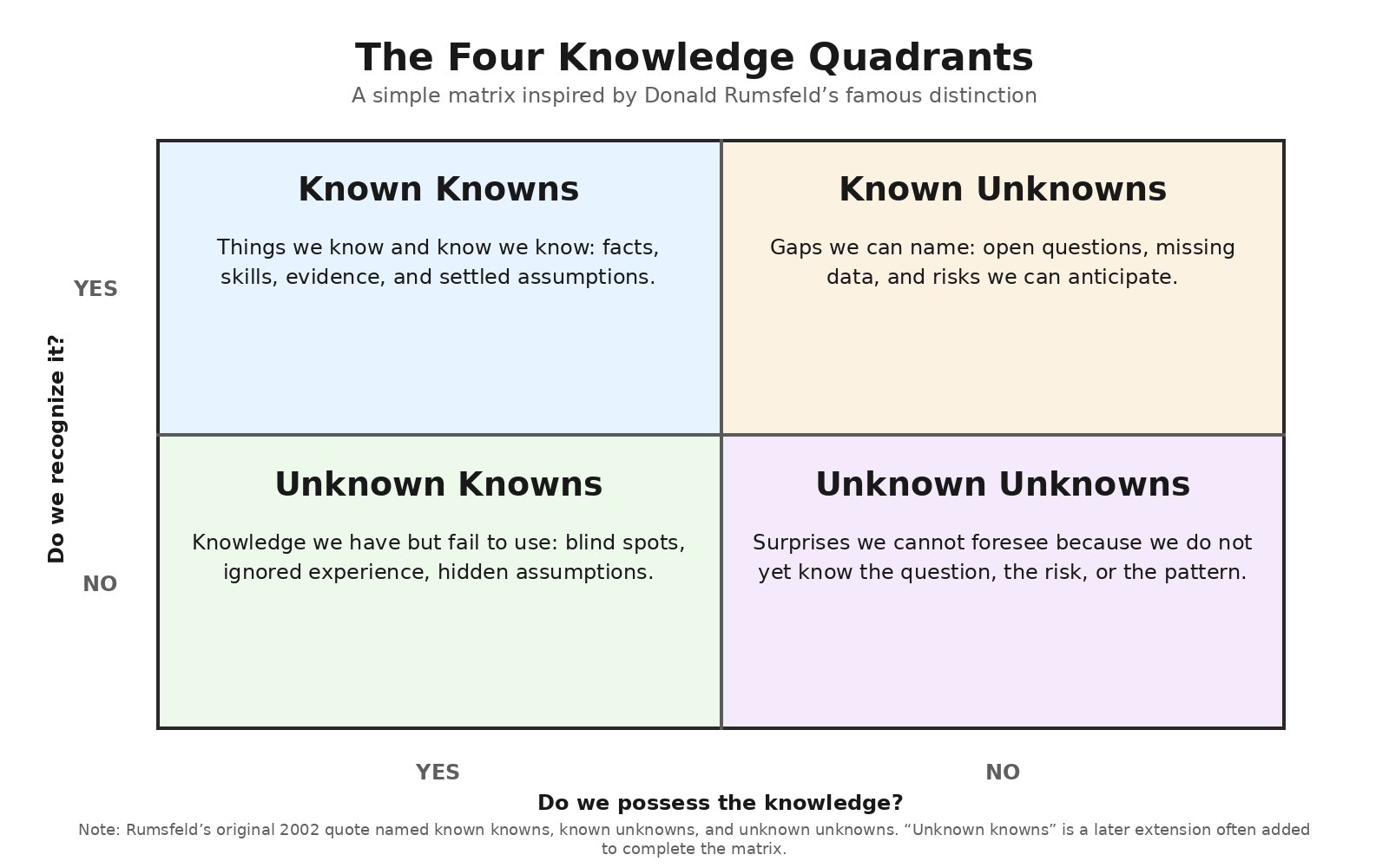
Known Knowns: What the team can state clearly
Known knowns are the things the team can say with confidence. We know the app must support SSO. We know the API must remain backward compatible. We know the checkout flow should finish in three steps or less.
These requirements give the agent solid ground. They define scope, boundaries, and success criteria. When teams write these clearly, the agent can produce useful code quickly and with less drift.
This is the easy part of requirements work, but teams should not underestimate it. Vague certainty still creates vague output. “Make it scalable” or “improve usability” sounds helpful, but it does not guide implementation. Specific requirements do.
Known Unknowns: What the team knows it has not decided
Known unknowns are the open questions already visible to the team. Should we support role-based access control now or later? Which payment provider comes first? Should we optimize for flexibility or simplicity in version one?
A good requirements process does not hide these questions. It names them. It assigns owners. It records temporary assumptions, so the agent has something to work with until the team makes a final decision.
This matters because AI coding agents do not pause and ask good follow-up questions unless the workflow forces them to. They tend to fill gaps with the most likely interpretation. Sometimes that works. Often it creates clean, convincing, wrong answers.
When the team makes uncertainty explicit, it keeps control.
Unknown Knowns: What the team knows but has not written down
Unknown knowns are often the most expensive category. These are things that someone on the team knows, but the requirements never capture.
The product manager knows enterprise customers need audit logs. The senior engineer knows that the legacy service breaks under high concurrency. The support team knows users always get confused during CSV import. Security knows a shortcut will fail the review. None of that helps the agent unless someone writes it down.
Teams often blame the agent for missing these requirements, but the real problem starts earlier. Hidden knowledge stays hidden. The system builds the wrong thing efficiently. This is where cross-functional input matters. Product, engineering, design, support, security, and operations each hold part of the truth. Teams need to pull that truth into the requirements before they hand work to the agent.
Unknown Unknowns: What nobody sees yet
Unknown unknowns are the surprises no one spots at the start. A dependency does not scale. A workflow breaks for real users. A regulation changes the design. An edge case turns out to be the common case.
No team can eliminate this category. Software always meets reality eventually. But teams can reduce the damage.
They can break work into smaller increments. They can review outputs early. They can test against realistic scenarios instead of polished demos. They can assume that something important will surface late and build the process to absorb that shock.
That mindset matters even more with AI coding agents because the speed of generation can create false confidence. A fast prototype can hide a deep misunderstanding. The code exists, the UI renders, and the tests pass, but the core requirement still misses the mark.
Why AI Coding Agents Raise the Stakes
Traditional development gives teams more time to notice confusion. AI coding agents compress that timeline. They turn weak requirements into working-looking systems at high speed. That sounds like a productivity win, and sometimes it is. But it also means the cost of ambiguous requirements shows up faster. The agent does not slowly drift off course. It sprints.
That is why requirements matter more, not less, when teams use AI coding agents. Better tools do not remove the need for clarity. They increase the returns on clarity and the cost of confusion.
How to find better requirements
Practices like behavior-driven development (BDD) and EventStorming are great to find better requirements. But before you jump to practice, make sure that you understand what matters.
Start with outcomes, not the implementation
Teams often begin with solutions: build a dashboard, add a chatbot, create an admin panel. That approach leads the agent straight into implementation before the team has defined success.
Start with the outcome instead. What should users achieve? What business results should change? “Build a dashboard” is weak. “Help account managers identify churn risks in under two minutes” is much stronger.
A clear outcome gives the agent direction. It also helps the team reject features that sound useful but do not move the result.
Use concrete examples
Abstract requirements hide ambiguity, examples expose it.
Describe the happy path. Show sample inputs and expected outputs. Add edge cases. Include examples of failure states, permissions problems, invalid data, and unusual user behaviour. The more concrete the requirement, the less the agent has to guess.
Examples also help teams discover disagreement early. People often think they agree until they react to the same scenario.
Write down constraints and non-goals
Good requirements do not just define what to build. They define limits.
State what must stay unchanged. State what the system must not do. State technical constraints, compliance requirements, performance limits, and integration boundaries. Add non-goals, so the agent does not expand the scope with plausible but unwanted features.
This matters because AI coding agents often optimize for completeness. If the requirements leave empty space, the agent may fill it with something that looks smart but creates work the team never asked for.
Pull hidden knowledge out of people’s heads
Many project risks are hidden within implicit knowledge. Someone knows where the real complexity sits. Someone knows which customers complain the most. Someone knows which dependency always fails under load.
Make that knowledge visible. Ask each function the same question: what would a smart outsider miss here? That question surfaces the unknown knowns that usually cause the most pain.
This step sounds simple, but it often separates successful AI-assisted delivery from expensive rework.
Define acceptance criteria that tests can verify
If a requirement matters, make it observable.
Do not stop at “the system should be fast” or “the experience should feel smooth.” Define thresholds. Define rules. Define what should happen when things go wrong. State permissions, validation, compatibility expectations, and measurable performance targets.
Clear acceptance criteria help the team evaluate output objectively. They also help the agent generate code and tests that align with the real goal.
Treat requirements as a living system
Requirements should not freeze at the start of the project. As the agent produces code, the team learns. Some known unknowns get resolved. Some unknown knowns finally surface. Some unknown unknowns become painfully obvious.
Strong teams feed those lessons back into the requirements immediately. They do not wait until the end and call the resulting rework “iteration.” They tighten the loop as they go.
With AI coding agents, that feedback cycle matters even more. The faster the build cycle runs, the more discipline the learning cycle needs.
Next
The real challenge is not getting code generated. That part keeps getting easier. The harder challenge is deciding what the code should do, what constraints it must respect, what trade-offs the team accepts, and what assumptions still need validation. That is why requirements matter so much for AI coding agents. They do not slow development down. They let speed work in your favour.
With this reminder of the importance of requirements, we can go and use workflows with Claude Code. Next week we explore how OpenSpec can allow us to go much faster.